What Darija is, and why textbooks miss it
Darija (الدارجة) is Moroccan Arabic: the language most Moroccans speak at home, at work and in the street. It grew from Arabic, mixed for centuries with Amazigh (Berber) languages, and borrowed words from French and Spanish. That is why a student of Standard Arabic can read every sign in Casablanca and still not follow the taxi driver.
Darija is mostly spoken, not written. There is no single official spelling, and schools teach Standard Arabic and French instead. So the fastest way in is the one children use: listen, notice, then speak, before worrying about reading.
You do not need Arabic script to start. Every phrase below is written the way it sounds, with the Arabic beside it for when you are ready.
If you want the bigger picture of Tamazight, French and Standard Arabic in Morocco, read What language is spoken in Morocco?
The sounds that trip up beginners
Moroccans who text in Darija use Latin letters plus a few numbers for sounds English does not have. You will see these everywhere, on WhatsApp and on shop signs, so learn them first:
Darija also drops many short vowels, so words come out in quick clusters: bzzaf (a lot), mzyan (good). Do not add vowels to make them easier; say them short and you will sound natural much faster.
28 survival phrases for your first weeks
Learn these in order. The first eight carry you through any greeting; the rest cover shopping, directions and getting un-stuck.
| Arabic | Say it | Meaning | When to use it |
|---|---|---|---|
| السلام عليكم | s-salamu 3likum | Peace be upon you · hello | Entering a shop, office or home |
| لاباس؟ | labas? | Are you well? | Right after salam, always |
| لاباس، الحمد لله | labas, l-hamdulillah | Fine, praise God | The standard reply |
| كي داير؟ / كي دايرة؟ | ki dayr? / ki dayra? | How are you doing? (to a man / a woman) | Friends, colleagues |
| صباح الخير | sbah l-khir | Good morning | Until about midday |
| مسا الخير | msa l-khir | Good evening | From mid-afternoon |
| عافاك | 3afak | Please | After almost any request |
| شكرا / بارك الله فيك | shukran / baraka llahu fik | Thank you / God bless you | The second is warmer |
| سمح ليا | smeh liya | Sorry · excuse me | Passing someone, interrupting |
| واخا | wakha | OK · alright | Agreeing to anything |
| إيه / لا | iyeh / la | Yes / no | |
| بغيت… | bghit… | I want… | Ordering, buying, asking |
| بشحال؟ | bshhal? | How much? | Markets, taxis, shops |
| غالي بزاف | ghali bzzaf | Too expensive | Opening a negotiation |
| فين…؟ | fin…? | Where is…? | fin l-mahatta? · where is the station? |
| كاين / ماكاينش | kayn / makaynsh | There is / there isn't | kayn l-khobz? · is there bread? |
| ما فهمتش | ma fhemtsh | I didn't understand | Your most useful sentence |
| عاود عافاك | 3awed 3afak | Say it again, please | |
| بشوية عافاك | b shwiya 3afak | Slowly, please | When people speak fast |
| سميتي… | smiti… | My name is… | |
| منين نتا؟ / منين نتي؟ | mnin nta? / mnin nti? | Where are you from? (man / woman) | You will hear it daily |
| أنا من غانا | ana men Ghana | I am from Ghana | Swap in your country |
| مزيان | mzyan | Good · nice | mzyan bzzaf · very good |
| دابا | daba | Now | ji daba · come now |
| غدا | ghedda | Tomorrow | |
| وقف هنا عافاك | wqef hna 3afak | Stop here, please | In a petit taxi |
| الله يعاونك | llah y3awnek | May God help you | To someone working, or to decline politely |
| بسلامة | bslama | Goodbye | Leaving anywhere |
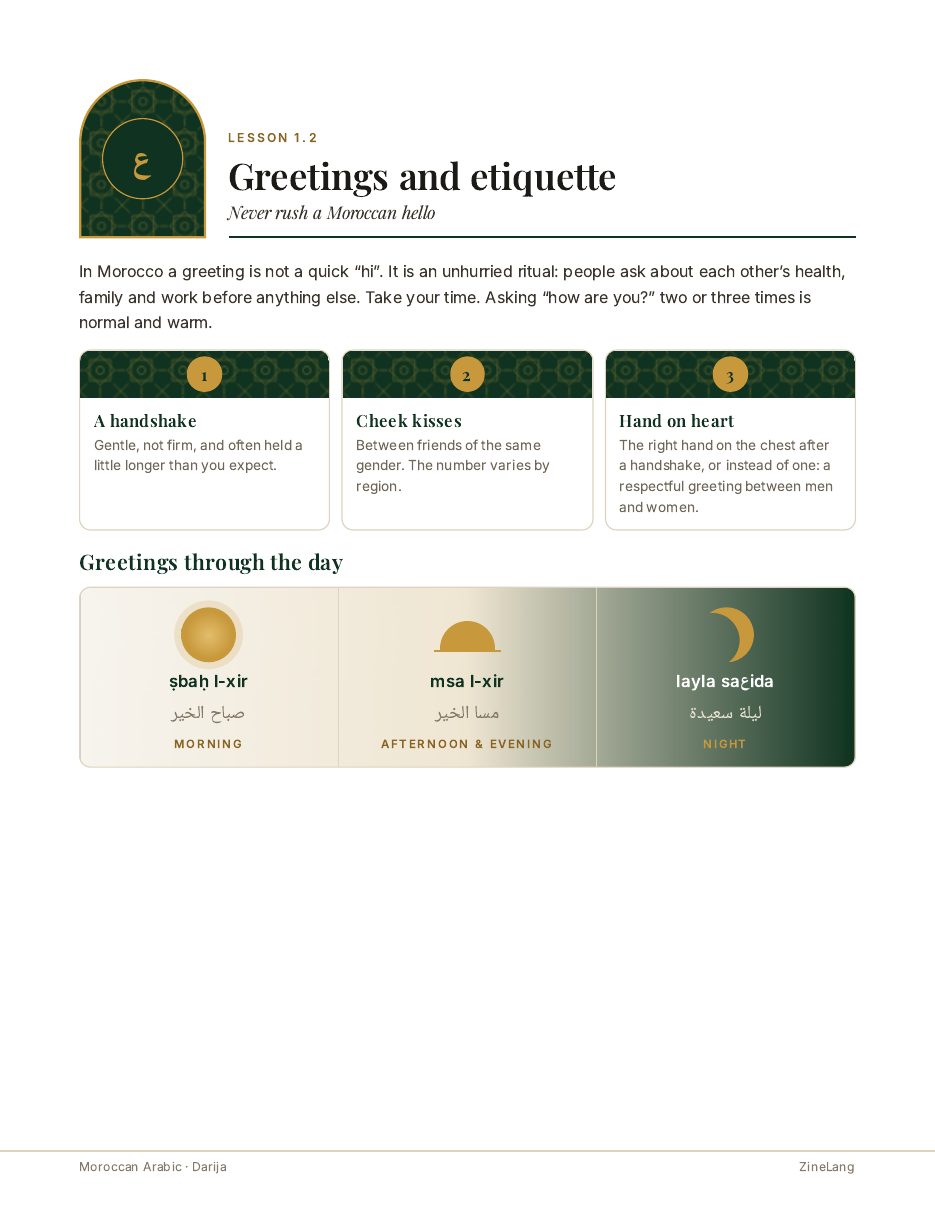
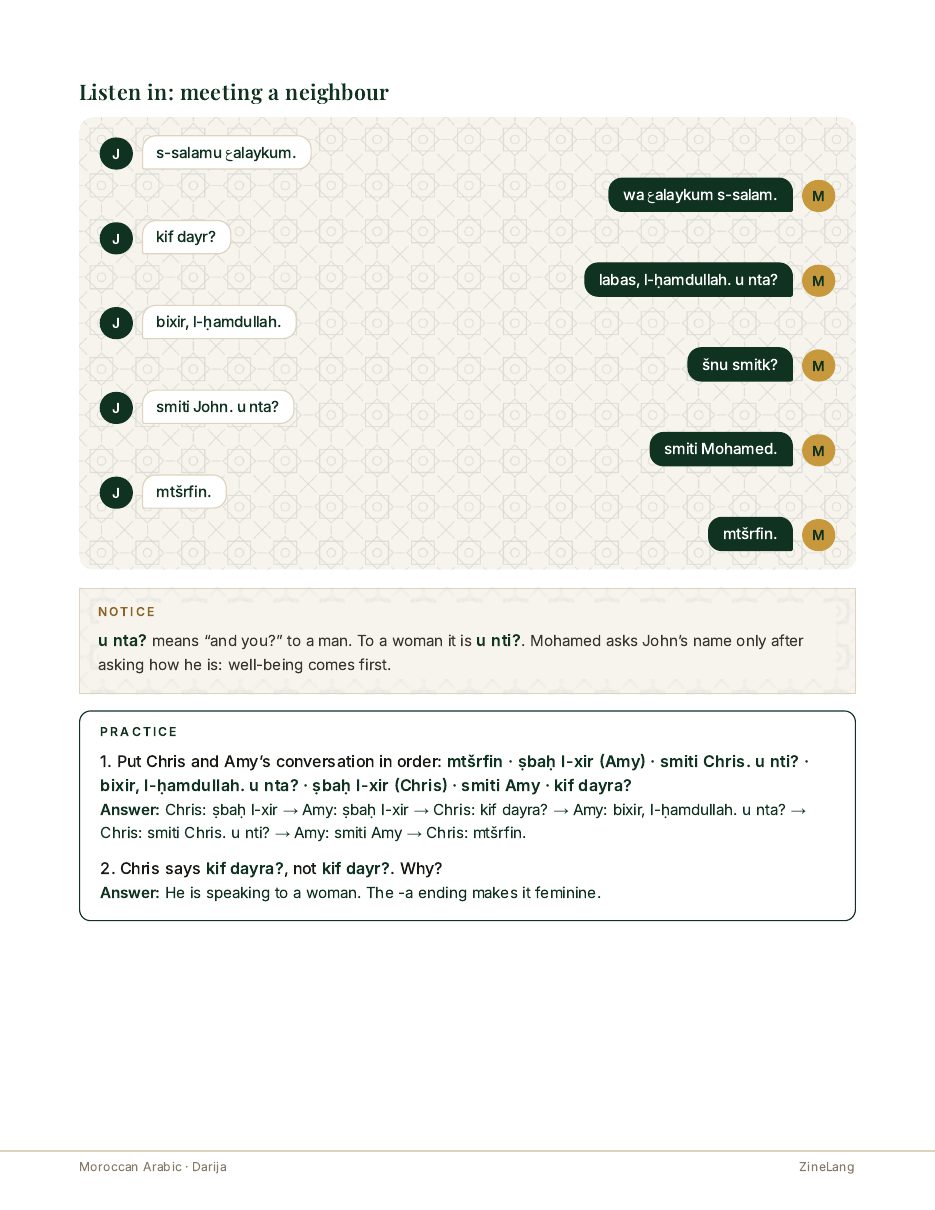
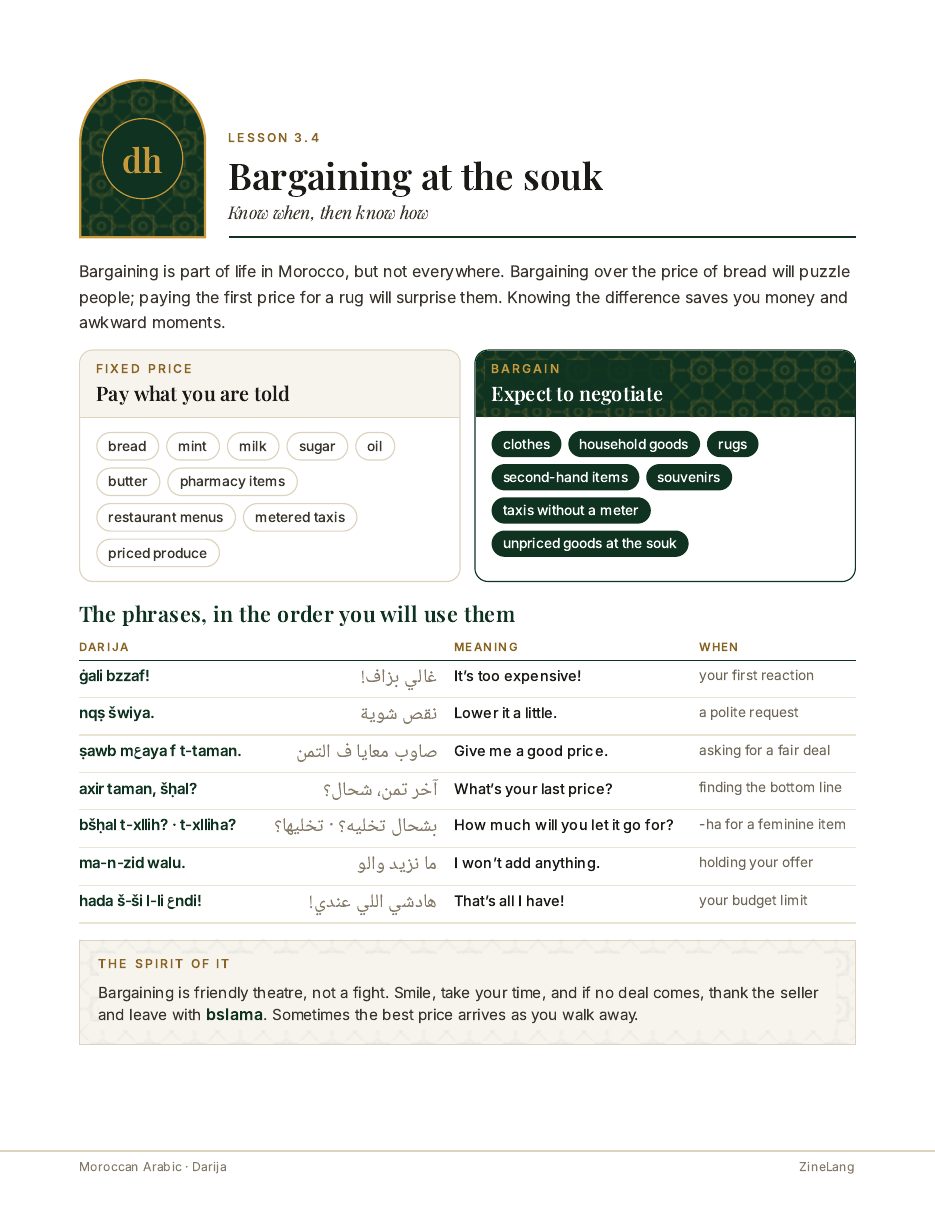
Look inside Darija Module 1
Real pages from the guide: every lesson pairs phrases with situations you will actually meet.
Numbers, prices and the "ryal" trap
| Number | Arabic | Say it |
|---|---|---|
| 1 | واحد | wahed |
| 2 | جوج | juj |
| 3 | تلاتة | tlata |
| 4 | ربعة | rb3a |
| 5 | خمسة | khamsa |
| 6 | ستة | stta |
| 7 | سبعة | sb3a |
| 8 | تمنية | tmnya |
| 9 | تسعود | ts3ud |
| 10 | عشرة | 3ashra |
Why prices sound twenty times too high
In markets you will often hear prices in ryal, an old unit still used in speech. 1 dirham = 20 ryal. So when a seller says miya ryal (100 ryal), they mean 5 dirhams, not 100. To convert, divide by 20. Some people, especially in the north, count in frank: 1 dirham = 100 frank.
"Alf ryal" (1,000 ryal) = 50 dirhams. If a price sounds absurd, ask: b d-dirham? (in dirhams?)
A real conversation: taking a petit taxi
This is the exchange you will have most often in your first month. Read it aloud twice.
Notice 3afak appears three times. Politeness in Darija is short and constant; use it with every request and people will answer you more warmly.
How to learn Darija: a 4-week routine
- Week 1 · Greetings and survivalThe first eight phrases above, every day, with everyone. Shopkeepers are your best teachers; greet them by name.
- Week 2 · Numbers and moneyCount everything you pay for out loud, in dirhams and in ryal. Ask "bshhal?" even when the price is written.
- Week 3 · Questionsfin? (where), shkun? (who), ash? (what), imta? (when). Ask one real question a day and listen for the answer, not just the words.
- Week 4 · One full conversationTaxi, grocer or neighbour: pick one situation and repeat it until it feels easy. Confidence in one situation spreads to the others.
Ten focused minutes a day beats a two-hour weekend session. Speak before you feel ready; Moroccans are patient with learners and will help you.
Learn it properly, in one PDF
Moroccan Arabic Module 1 takes you from greetings to bargaining at the souk, with phonetic spelling, dialogues and exercises with answers. Prefer a person? Your first live lesson is free.
Questions learners ask
Is Darija hard to learn?
The sounds take a few days to get used to, but the grammar of everyday Darija is simpler than Standard Arabic: fewer verb forms and no case endings. Most newcomers handle greetings, shopping and taxis within a few weeks of daily practice.
Should I learn Standard Arabic or Darija first?
If you live in Morocco and want to talk to people, start with Darija. If your goal is reading the Quran, newspapers or official documents, start with Standard Arabic. Many words are shared, so each one helps the other later.
Can I learn Darija without the Arabic alphabet?
Yes. Most Moroccans text Darija in Latin letters with numbers such as 3 and 7, so you can learn to speak and even text without reading Arabic script.
Do people in Morocco speak French or English?
French is widely used in business, administration and higher education, and English is common among younger people in cities and tourist areas. In everyday life, markets, taxis and neighbourhoods, Darija is what you will hear.
How long does it take to learn Darija?
With 10 to 20 minutes a day and real practice, most learners hold short daily conversations within one to three months. Fluency takes longer, but being understood comes surprisingly early.