What a good beginner PDF should do
Most free Arabic PDFs are either alphabet charts or grammar books written for university students. A beginner needs something in between: a guide that teaches the letters, then immediately uses them in real words, so every lesson pays off the same day.
- Pronunciation on every word, so you are never stuck on a word you cannot say.
- Roots early, because one three-letter root unlocks five to ten words.
- Words you already know, like bismillah and alhamdulillah, as the starting point.
- Short chapters with answers, so you can check yourself without a teacher.
Look inside Arabic for Muslims Level 1
Real pages, not a mock-up
Clear layout, pronunciation under every word, and a quick review at the end of each chapter.
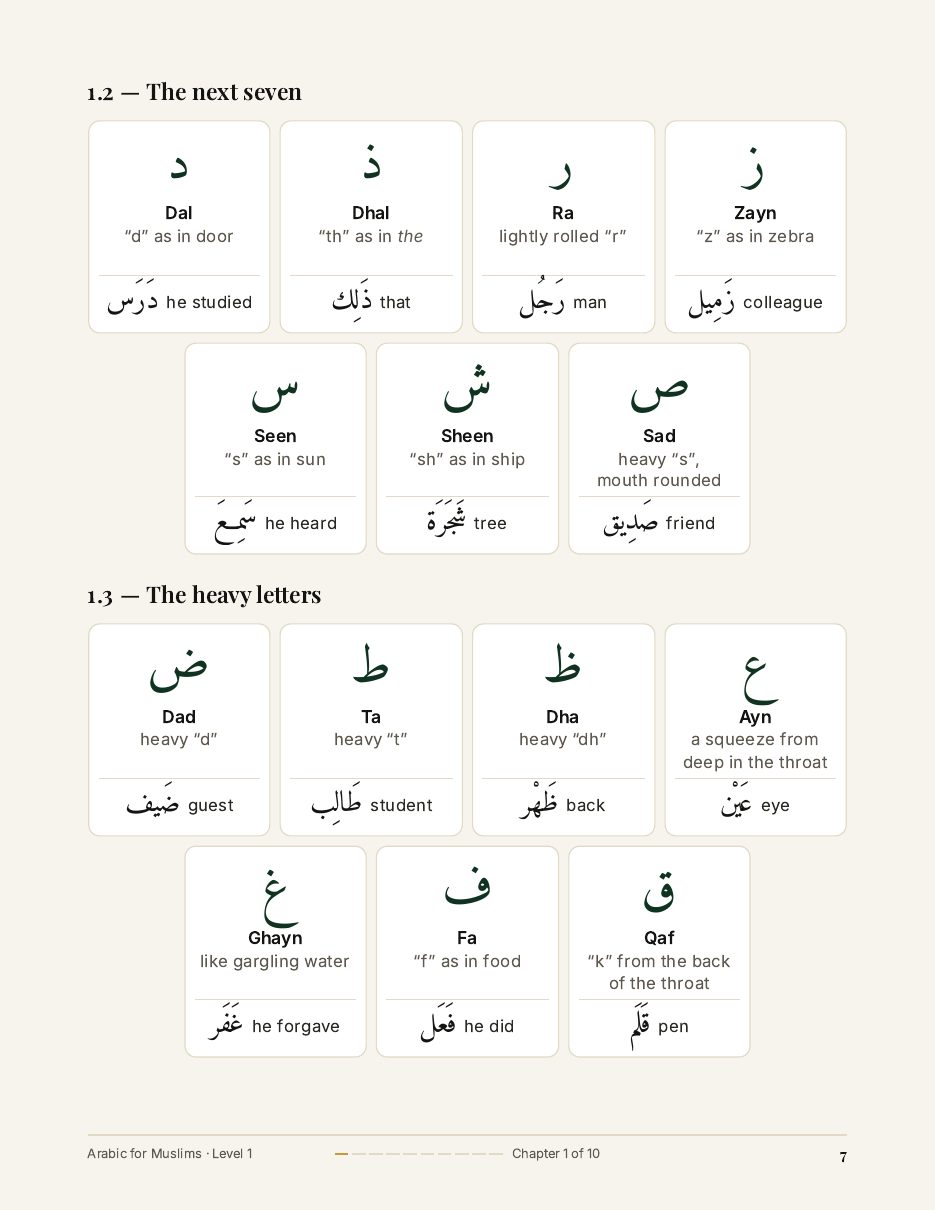
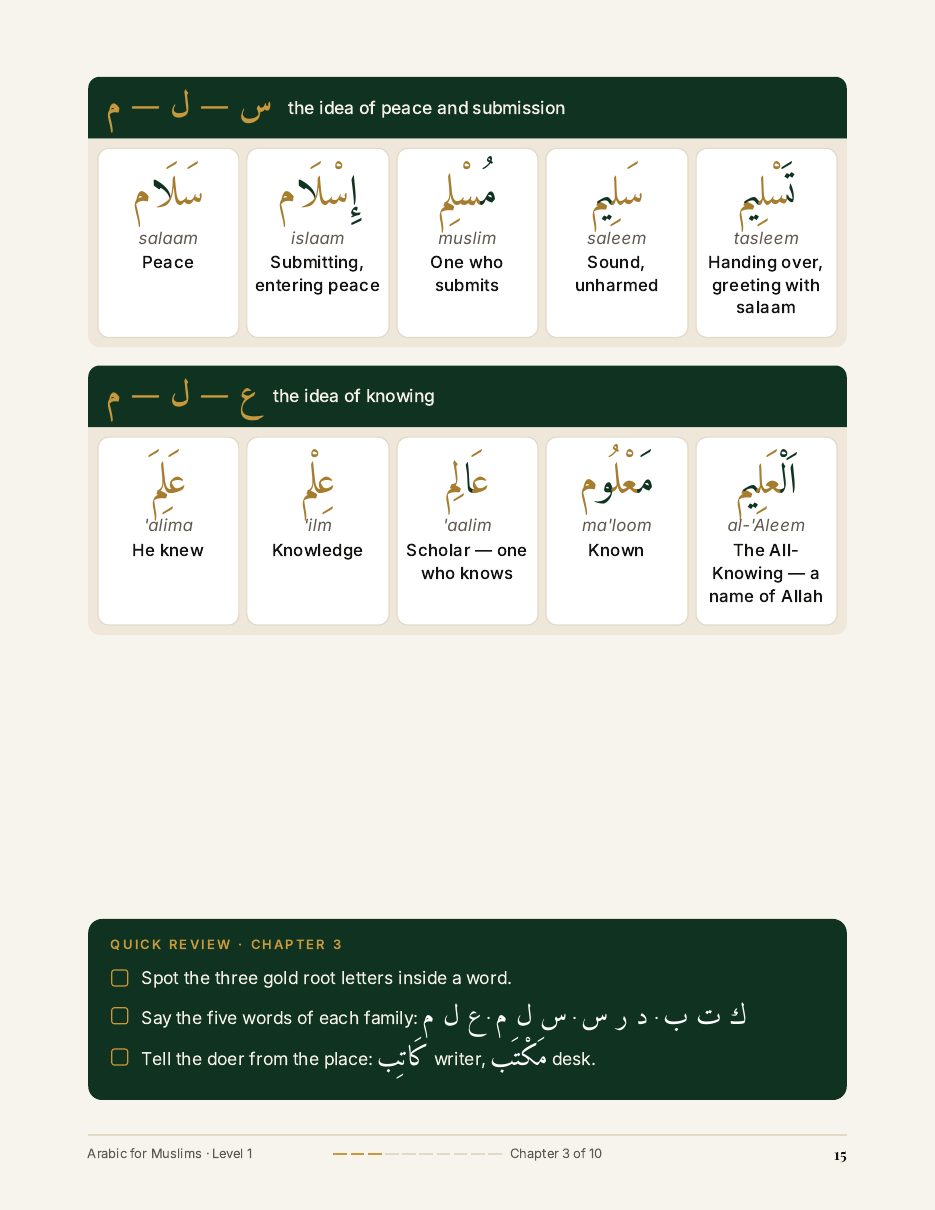
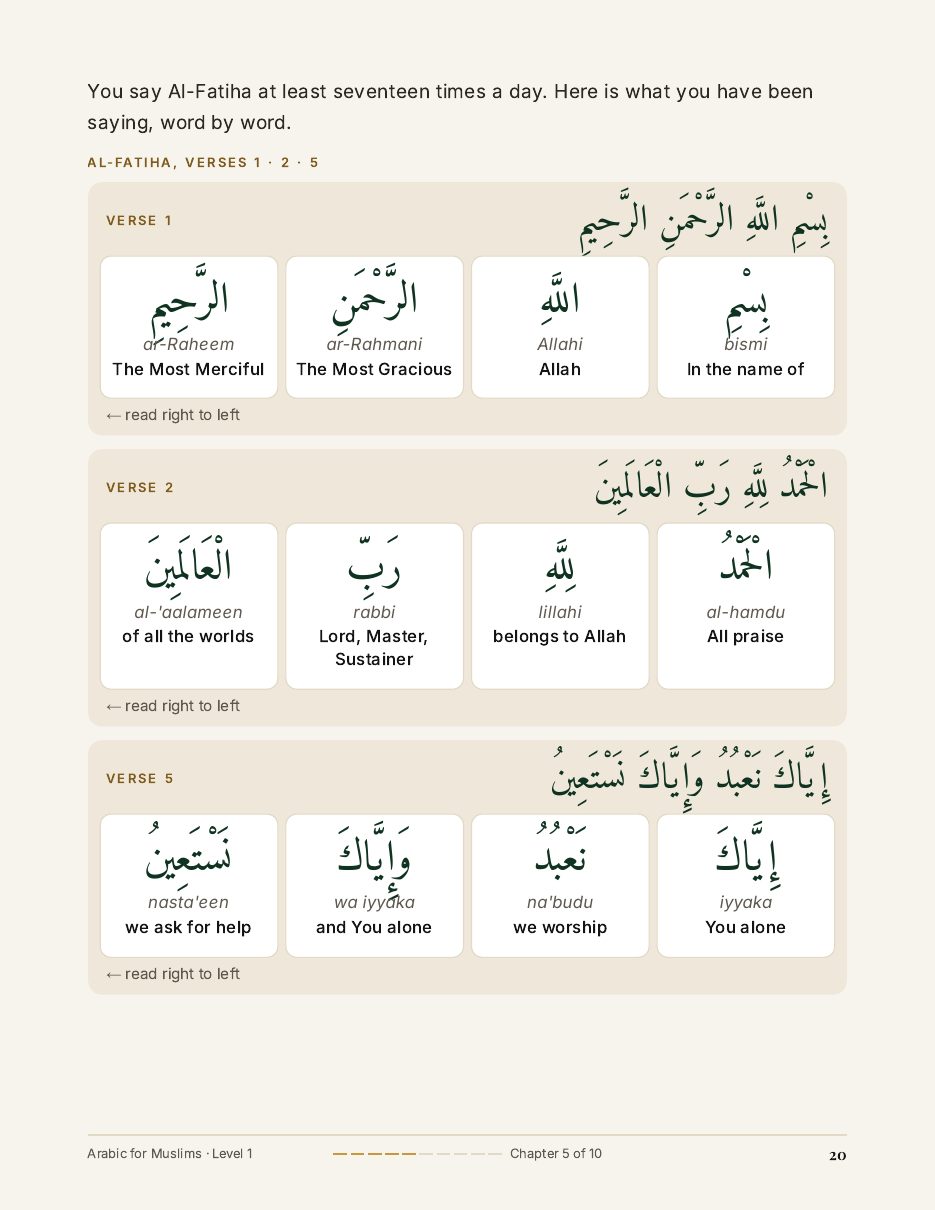
These are real pages from the guide, exactly as you receive them.
The 10 chapters, in order
- The lettersAll 28 letters in small groups, with the three short-vowel marks
- First wordsHome, people and the masjid
- Word familiesHow one three-letter root makes many words
- Your first sentencesThis is, that is, masculine and feminine, question words
- Words you already reciteAl-Fatiha word by word
- Action wordsVerbs, and the names of Allah that come from them
- Describing thingsOpposites and colours
- Phrases you say dailyWhat each word in bismillah, alhamdulillah and in sha Allah means
- NumbersOne to ten
- PracticeExercises with full answers
Who it is for
Level 1 is for complete beginners: Muslims who want to understand what they recite in salah, converts, parents learning alongside their children, and anyone curious about the language of the Quran. It is written in simple English, and our team answers questions in English, French and Arabic.
If you live in Morocco and mainly want to talk to people, start with Moroccan Darija instead. And if you are curious which language Moroccans actually use day to day, read What language is spoken in Morocco?
The full series
| Guide | Level | What you learn | Price |
|---|---|---|---|
| Arabic for Muslims · Level 1 | Beginner | Letters, roots, Al-Fatiha, daily phrases, numbers | $9 |
| Arabic for Muslims · Level 2 | Next step | Past and present tense, adjectives, prepositions, Al-Ikhlas and Al-Kawthar | $12 |
| Arabic Root Families | Vocabulary | 40 flashcards, 8 root families with Quranic examples | $7 |
| Moroccan Arabic · Module 1 | Beginner | Spoken Darija for life in Morocco | $7 |
Start Level 1 today
Instant PDF, ten short chapters, pronunciation on every word and answers to every exercise. Not sure yet? Get the free sample lesson first.
Questions learners ask
Is there a free Arabic for beginners PDF?
Yes: request our free sample lesson from Level 1 using the button on this page. Our free guides on this website, such as Common Arabic phrases, are also free to read with no sign-up.
Can I learn Arabic on my own with a PDF?
Yes, if the guide gives you pronunciation for every word and answers to every exercise. Ten to twenty minutes a day, one chapter at a time, is enough to finish Level 1 in a few weeks.
Is this Quranic Arabic or Modern Standard Arabic?
Both share the same alphabet, roots and core grammar. Level 1 uses the Quran as its main text, so you learn the words you recite, but everything carries over to Modern Standard Arabic.
How do I receive the PDF?
After payment you get an instant download link by email. No app and no subscription: the file is yours on any device.